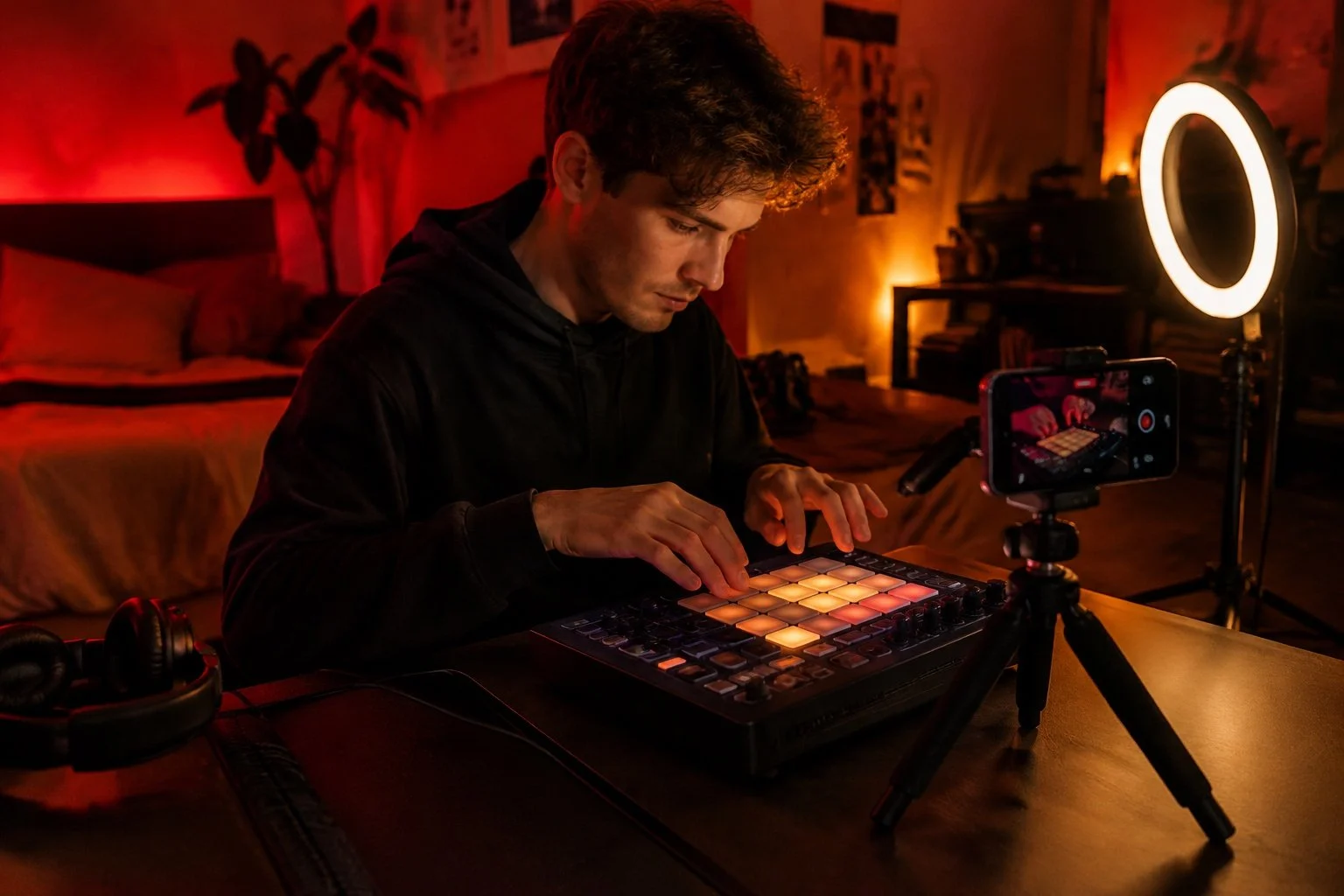
Think of Your First Kit Like a Food Truck
Quick answer: You don't need 50,000 followers to sell a sound kit. You need a small, high-quality kit (around 25 sounds), a free storefront like Payhip or Gumroad, a free teaser pack that demonstrates your sound, and short videos showing other producers how your sounds work in a beat.
Your audience can grow from the kit itself, rather than needing a huge audience before you launch.
Think of your first kit like a food truck, not a supermarket. A supermarket wins by stocking everything. A food truck wins by doing a few things so well that people tell their friends. Most beginner sound kits fail because they try to offer too much instead of focusing on quality.
STEP 1: PICK ONE SOUND PEOPLE CAN RECOGNIZE
Before recording anything, finish this sentence:
"This kit is for producers who want ______."
Good examples include:
Dusty soul chops for boom bap.
Detuned 808s for Jersey club.
Foley percussion recorded in a hardware store.
Dark ambient textures for cinematic trap.
Vintage drum breaks for lo-fi hip-hop.
A focused kit is easier to describe, promote and remember.
"Hip-hop drums" is too generic. "Drums sampled from a broken church piano and a filing cabinet" gives people a reason to click.
STEP 2: CURATE 25 SOUNDS, NOT 500
One of the biggest mistakes beginners make is filling their kits with hundreds of average sounds.
Buyers don't want to dig through 500 files to find six good ones. They want sounds they can immediately use.
A good first kit could contain:
8 melodic loops or chops: Hooks and musical ideas that help producers start a beat.
8 one-shot drums: Kicks, snares and percussion with your own character.
3 808s or bass sounds: Properly tuned and labeled with their keys.
4 textures and effects: Risers, vinyl noise, foley and atmospheric sounds.
2 bonus files: MIDI files or stems from one of your loops.
Important rules:
Label everything: Use descriptive filenames like SK_Chop_Rainroom_92bpm_Fm.wav instead of loop3_final_v2.wav. Include the key and BPM whenever relevant.
Export clean: Use 24-bit WAV files, trim unnecessary silence, avoid clipping and keep volume levels consistent.
Only use sounds you own: Don't sell uncleared samples from copyrighted records. Stick to original recordings, your own synth patches and properly licensed material.
Include a license: Add a simple one-page document explaining that buyers can use the sounds royalty-free in released music but cannot resell or redistribute the original files.
Quality matters more than quantity. Every sound should have a purpose.
STEP 3: SELL IT WITHOUT A MONTHLY BILL
You can launch your first sound kit without paying for a subscription.
Here are three options:
1. Payhip
Free to create an account and upload products.
Charges 5% per sale on its free plan, plus payment processing fees.
Handles EU/UK VAT and US sales tax.
Good if you want to keep more of each sale.
Website: https://payhip.com
2. Gumroad
Free to get started.
Charges 10% + $0.50 per direct sale.
Charges 30% for sales through its Discover marketplace.
Acts as the merchant of record for tax handling.
Good if you want a simple setup.
Website: https://gumroad.com
3. Google Drive
Free storage up to your available 15 GB.
Useful for distributing free teaser packs.
Doesn't provide checkout, payment processing or license tracking.
Website: https://drive.google.com
My recommendation is to use Payhip or Gumroad for your paid kit and Google Drive or your storefront for the free teaser.
A storefront also helps you collect customer email addresses, which gives you a way to reach people when you release future kits.
Pricing your first kit:
For a 25-sound kit, start somewhere between $10 and $20.
You can also offer a free teaser pack or a pay-what-you-want option to encourage people to try your sounds.
STEP 4: EARN TRUST WITH A FREE TEASER KIT
Most strangers won't immediately spend $15 on sounds they've never heard.
Give them a reason to trust your product first.
Create a free mini-kit containing 5–6 of your best sounds. Think of it like a bakery handing out free samples.
Here's how to do it:
Select the teaser sounds from the same recording sessions as your paid kit.
Make sure the free sounds demonstrate the quality of the full product.
Ask people for their email address when downloading.
Include a README file with a link to your full kit.
One week after someone downloads it, send them a short beat made using sounds from the complete kit.
The goal is simple: let people experience your sound before asking them to buy it.
STEP 5: POST VIDEOS THAT SHOW YOUR SOUNDS WORKING
Producers don't just want to hear isolated samples. They want to know what those sounds can do inside an actual beat.
Short videos on TikTok, Instagram Reels and YouTube Shorts are great ways to demonstrate this without spending money on advertising.
Here are four video formats to try:
1. Sample to beat in 60 seconds
Show the original sound, how you chopped or processed it, and the finished beat.
2. Before and after
Play a basic stock kick, then play your processed version. Show the difference your sound makes.
3. Where the sound came from
Film the actual objects you recorded. This could be a filing cabinet, an old piano, rain hitting a car roof or anything else that creates interesting sounds.
4. Flip challenges
Share a sample and challenge other producers to make something with it.
For example: "I made this sample pack from sounds around my house. Here's one of the samples. Show me what you can make with it."
Give people access to your free teaser through the link in your bio.
Tips for making better videos:
Make the first second visually and sonically interesting.
Show your hands, equipment, DAW or waveform.
Demonstrate the sound in an actual beat.
Post consistently. Three short videos a week is a good starting point.
Keep your storefront link in your bio.
Don't just post pictures of your kit's cover art. Show people what they're actually buying.
STEP 6: USE DISCORD BEAT BATTLES AND PRODUCER COMMUNITIES
Producer communities are great places to introduce your sounds to people who might actually use them.
Find a few active producer Discord servers and beat battle communities.
However, don't immediately join and start posting links to your product. Spend some time participating and contributing first.
Once you've become part of the community, try these strategies:
Offer your teaser kit for a beat battle: Let everyone use your samples to create their entries. Each finished beat becomes another demonstration of your kit.
Sponsor a small prize: Give the winner your full sound kit and feature their beat on your page.
Repost the best flips: Ask producers for permission to share their creations and always give them credit.
Build relationships: Talk to other producers, exchange feedback and collaborate.
Always follow each server's self-promotion rules.
The goal is to become a useful member of the community, not someone who only shows up to sell something.
STEP 7: MEASURE YOUR RESULTS AND MAKE KIT NUMBER TWO
After your first 30 days, look at how people are responding.
Pay attention to three things:
1. Teaser downloads
How many people are interested enough to download your free sounds?
If downloads are low, you might need better videos, stronger hooks or more effective promotion.
2. Free-to-paid conversions
How many people who downloaded your teaser actually purchased the full kit?
If people download but don't buy, consider whether your full kit offers enough additional value.
3. Video performance
Which videos generated the most clicks, downloads and interest?
Make more content around the formats that work.
Example:
Imagine 200 people download your free teaser pack.
Out of those 200 people, 10 purchase your full kit at $15 each.
That's:
200 potential customers.
10 paid customers.
$150 in gross sales before fees.
200 email contacts for your next release.
Your second kit becomes easier to launch because you already have a product template, storefront, experience and an audience.
Eventually, you can bundle your first and second kits together at a discounted price.
COMMON MISTAKES TO AVOID
1. Uploading 500 unlabeled sounds
Fix: Start with 25 carefully selected, named and properly organized sounds.
2. Selling uncleared samples
Fix: Only sell original recordings or properly licensed material.
3. Not offering anything for free
Fix: Create a teaser kit that lets people experience your sound before purchasing.
4. Only posting product artwork
Fix: Show your sounds being used in actual beats.
5. Spamming Discord links
Fix: Participate in communities, contribute value and introduce your sounds naturally.
6. Forgetting the license
Fix: Include a simple document explaining how buyers can use your sounds and what they cannot redistribute.
FAQ
How many sounds should my first kit have?
Around 20–30 sounds. That's enough to create a valuable product without filling it with unnecessary files.
Do I need to register a business before selling?
Not necessarily. In many places, you can start selling without registering a business immediately. However, income from sales is generally taxable, so keep records and check the rules where you live.
Should I use Gumroad or Payhip?
Payhip generally takes a smaller platform fee on its free plan (5% compared with Gumroad's 10% + $0.50 for direct sales). Gumroad acts as the merchant of record, which can simplify tax handling. Both are reasonable options for a first launch.
Can I sell loops that sample old records?
Not safely without the necessary permissions. Selling uncleared samples can expose both you and your customers to copyright claims. Stick to original recordings or properly licensed material.
What if nobody buys my first kit?
Don't immediately give up.
Keep your teaser pack available, continue posting beat-making videos and build relationships with other producers.
Your first kit isn't just about making money. It's also about building a reputation, developing your sound and collecting an audience that might buy your future releases.
THE BIGGEST THING TO REMEMBER
You don't need to be famous to sell sounds.
You need to create something recognizable, make it genuinely useful, demonstrate its quality and put it somewhere people can buy it.
Start with 25 great sounds. Give away five. Post three videos a week. Get your first customers. Then make the next kit better.
Don't spend six months trying to build an audience before releasing anything. Build the product, release it and let the product help build the audience.