The Latest Underground Music News: The Scene Is Moving Faster Than the Industry
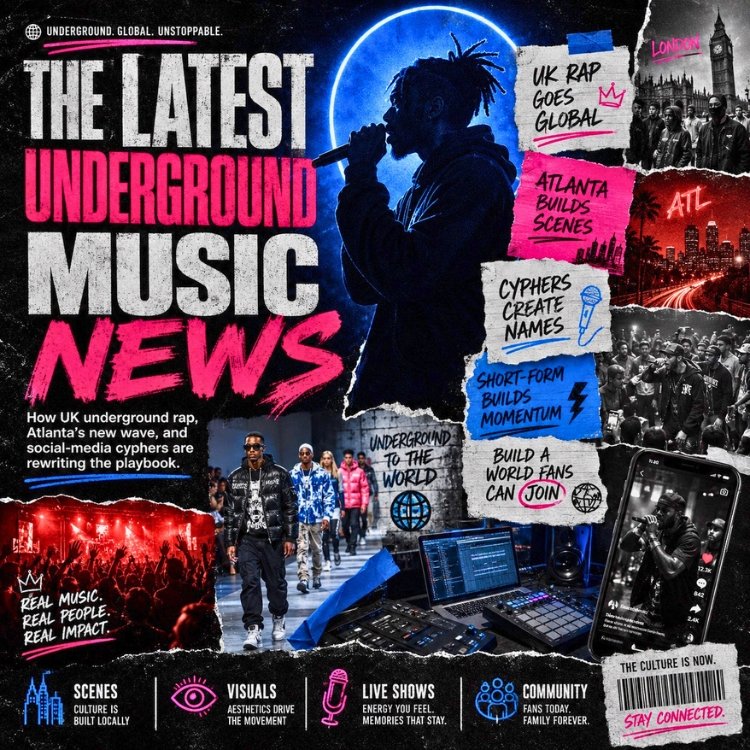
Sampledex: Thea Latest Underground Music News
UK Underground rap, Atlanta’s New Wave, and Social-Media Cyphers
The underground is not underground in the way it used to be. Today, scenes move through fashion shows, festival stages, SoundCloud uploads, TikTok edits, Instagram reels, YouTube cyphers, Discord servers, and fan-made mood boards before traditional music media even catches up. What once stayed local for years can now become global in weeks. Right now, the biggest story is simple: UK underground rap has crossed into global fashion and festival culture, while Atlanta’s newest underground movement and social-media cypher ecosystems are creating the next generation of names. For artists and producers, the lesson is becoming harder to ignore: build a recognizable sound, connect it to a scene, create moments designed for repeat viewing, and give fans something bigger than songs to belong to. This is not simply music news anymore. It is infrastructure.
UK Underground Rap Has Become a Global Signal
The most important underground story right now remains the rise of UK underground rap, where artists like EsDeeKid, fakemink, Feng, and a growing network of internet-native acts are turning regional identity into exportable culture. What makes this movement work is that it does not feel like imitation. The accents remain intact, the slang stays local, the references are hyper-specific, and the visuals feel messy, fast, and distinctly British. That specificity is exactly why it travels. The Guardian described the movement as loud, digital, punk-like, and globally visible, but more importantly, it feels like a youth movement rather than simply a collection of artists. Artists spend too much time trying to sound universal when audiences increasingly reward specificity. Your city matters, your slang matters, your references matter, and your weirdness matters. The internet rarely rewards the safest version of an artist. It usually rewards identity.
Fashion Is Paying Attention Because Culture Moves Faster Than Luxury
One of the clearest signs that underground music has entered a new phase is fashion’s growing obsession with internet rap. GQ’s coverage of underground names appearing around Gucci’s Fall 2026 moment showed something important: luxury brands are no longer waiting for artists to become mainstream before attaching themselves. The same pattern appears elsewhere, including OsamaSon’s Balenciaga campaign. Fashion wants what feels early. Fashion wants scenes before they become industries. Fashion wants artists who already built worlds. For independent artists, this should change how visuals are treated. Visual identity is not extra. It is business. Your clothes, cover art, stage design, photography, logos, merch, and videos all teach audiences how to understand your music before they even press play. A fan may not know every lyric, but they will remember colors, silhouettes, masks, logos, and worlds. The lesson is simple: stop treating visuals like promotion. Visuals are memory.
Fakemink Shows Both the Opportunity and the Pressure
Few artists currently represent internet-era acceleration better than fakemink. His rise has happened at modern speed: underground hype, fashion attention, festival bookings, critical coverage, fan discourse, and constant online conversation happening simultaneously. That speed creates opportunity, but it also creates pressure. When artists grow quickly, weaknesses become visible faster. Live performances matter more. Songwriting matters more. Brand consistency matters more. Fan relationships matter more. Mystery alone eventually stops working. The lesson for artists and producers is simple: attention is only step one. Retention is the real business. Hype opens doors. Craft keeps them open.
Atlanta’s New Wave Is Rebuilding Scene Culture
While the UK wave dominates headlines, Atlanta’s newest underground movement is quietly rebuilding something equally important: scene energy. Artists connected to names like Zukenee, Sk8star, Tezzus, diamond*, Pradabagshawty, and ØWay are helping restore something Atlanta historically does better than almost anywhere else: movement. Atlanta has rarely been built around individual stars. It has always been ecosystems made up of producers, crews, studios, neighborhoods, shared aesthetics, shared slang, and shared momentum. Many artists still try building entirely alone, but scenes move faster. A producer becomes more valuable when attached to a movement. Videographers become important when they define visual language. Designers become important when they create uniforms. Artists should stop asking only how to build themselves and start asking what scene they are helping create.
Social-Media Cyphers Are Becoming Discovery Engines
Another major shift is the rise of social-media cypher ecosystems. Projects like the UGS 2026 Cypher show how quickly artists can gain visibility when attached to repeatable formats. Cyphers work because they create participation. Fans debate verses, clip moments, repost favorites, argue, and create memes. Modern discovery increasingly depends on formats rather than isolated releases. A cypher is a format. A freestyle series is a format. A beat challenge is a format. A producer breakdown is a format. A parking-lot performance is a format. Random content disappears. Formats create habits, and habits create audiences.
Short-Form Content Works Best When It Creates Moments
Short-form content remains one of music’s strongest discovery tools, but artists often misunderstand why. People rarely share content because it exists. They share moments. A moment can be a hook, a crowd reaction, a weird beat switch, a funny line, a studio argument, a producer flipping a sample, a fan screaming lyrics, or a chaotic backstage clip. Artists like BunnaB understand this instinctively. The internet rarely rewards only the best song. It more often rewards the clearest personality attached to the song. The lesson is not to become fake. The lesson is to become recognizable.
Producers Are Quietly Becoming Scene Leaders
The underground is not only creating new rappers. It is creating new sounds. That means producers have more leverage than ever. Every scene needs producers, and every movement needs sonic architects. Producers who build recognizable identities increasingly become cultural anchors rather than background contributors. That means producers should stop hiding behind anonymous beat uploads. Your drums should feel recognizable. Your melodies should feel recognizable. Your visuals should feel recognizable. Your thumbnails should feel recognizable. Your sample packs should feel recognizable. Do not simply sell beats. Sell worlds.
Live Shows Are Becoming Proof of Concept
Online attention matters, but live performance proves whether attention is real. As underground artists increasingly move into festival spaces, performance quality matters more than ever. A live show is not simply music. It is evidence. Do fans know lyrics? Do they dress like the scene? Do they buy merch? Do they record moments? Do they return? Artists should rehearse accordingly by practicing breath control, transitions, crowd interaction, endings, and openings. Virality gets bookings. Performance gets careers.
Merch Is Becoming Part of the Narrative
The underground is also proving something many artists still underestimate. Merch is not extra income. Merch is identity. When fans wear artist merchandise, they are publicly signaling belonging. That means merch should feel connected to the world around the music. Start small with one shirt, one hoodie, one poster, one cassette, one sticker pack, or one limited item. Do not simply sell products. Sell proof that fans were there early.
The Business Lesson: Own the Room
The biggest lesson from today’s underground is ownership. Artists use TikTok, Instagram, YouTube, SoundCloud, Spotify, and X for discovery, but discovery is not ownership. You need direct relationships through email lists, text lists, Discord servers, websites, Patreon communities, and Bandcamp pages. Think about fan relationships like architecture. Social media is the street. Your link is the door. Your email list is the room. Your merch store is the shop. Your live show is the gathering. Bring fans deeper.
What Artists Should Learn Right Now
The underground is showing artists exactly where things are heading. Build recognizable sounds. Build visual worlds. Release consistently. Create moments. Join scenes. Perform often. Collect fan information. Sell simple products. Collaborate. Track responses. Stop waiting for permission. The artists winning right now are not necessarily the most talented. They are often the easiest to believe in.
What Producers Should Learn Right Now
Producers should move with equal urgency. Develop sonic identities. Create visual consistency. Build communities. Post process content. Create products. Collaborate locally. Host sessions. Release music. Build ecosystems. Do not simply become a producer. Become infrastructure.
Final Takeaway
The latest underground news is bigger than a few artists getting hot. It represents a structural shift. UK underground rapis proving local identity scales globally. Fashion crossovers are proving underground artists can become cultural signals. Atlanta’s new wave is proving scenes still matter. Cypher culture is proving formats create stars. Short-form moments are proving personality travels faster than polish. The underground is no longer waiting in the basement. It is building the next floor. For artists and producers, the message is clear: build recognizable sounds, attach them to scenes, create moments, build worlds, and give fans something to join before the industry catches up. Because the industry has always chased what already feels alive.